

Why everyone's creative practice should contain teaching
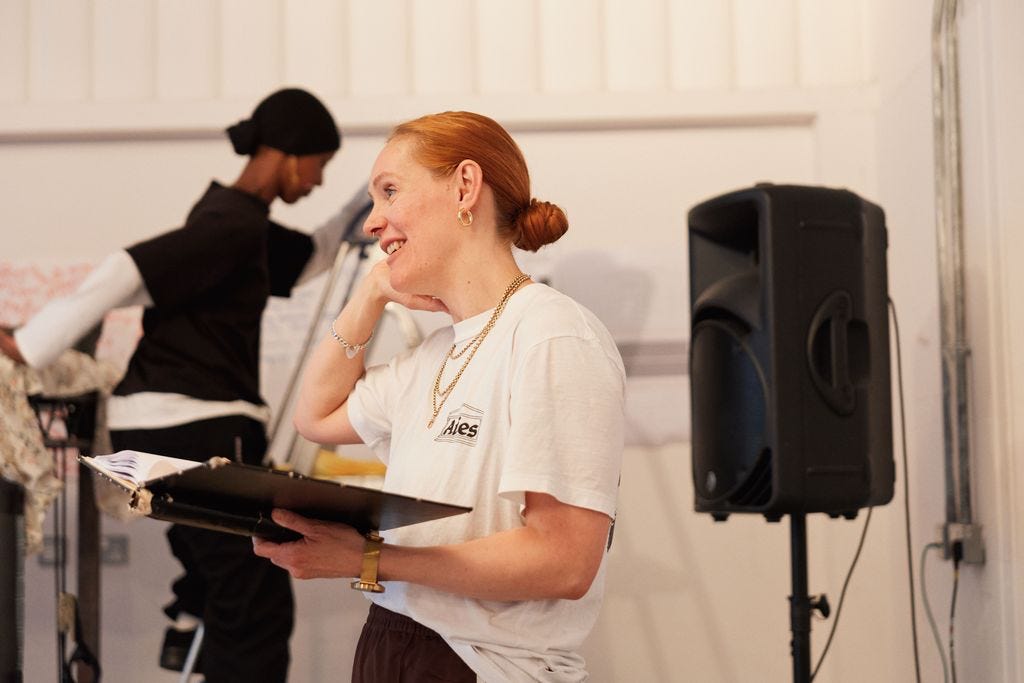
👀 A look inside the workshop I'm leading tomorrow

Dear friends,
Tomorrow, I’m heading to Northern School of Contemporary Dance to spend a day workshopping with their graduate students. These dancers are exploring directing as part of their training, and I can’t wait to share my manifesto with them for what it means to be a great director.
I love working with MA students. I think it’s one of the most exciting times to intervene in an artist’s career. A person who has already demonstrated commitment and depth - as well as having some life experience and wider understanding of the world to bring to their practice. You can, of course, do an MA at any age. I’ve worked with MA students between the ages of 22 and 67 - and had deeply fulfilling experiences with many of them. From time to time, I lecture on the MA in Creative Writing at Oxford University, as well as working with the MA musical theatre students at LAMDA to explore discomfort. Last year, I directed the MA musical theatre graduating show at Central School of Speech and Drama - and our production of Carrie was as brutal and dark and brilliant as anything I’ve directed lately.
In my experience, MA students have the magic trifecta: knowledge, enthusiasm and skill. They have enough knowledge to make great work but also to be so aware of what they still don’t know. They’re open and available to what you have to say - but they’re also bound to teach you loads as well. They have deep, profound enthusiasm for their craft - born of a real commitment to following it that comes with the significant investment (of time, of money, of hope) that comes with an MA. And they are honing their skills in such a way that they are bound to surprise you. They are still learning the rules, they are still assembling their toolkit - so, their contributions to a workshop or a rehearsal room are often unusual. I love working with them.
I hope this hasn’t happened to me, but as a director, I fear becoming stuck in my ways: so dedicated to my process, which I massively believe in, that I forget to stay open minded to the new. Directors are unique in theatre in that we don’t get to see inside other people’s rehearsal rooms - unlike any of our other creative colleagues, from stage management to designers to actors. When I was an assistant director - and I was hopeless, because I always wanted to be In Charge, that role drove me crazy - the one huge benefit was being allowed to see how other people’s processes worked, how they constructed a room and put a show together.
So, this is my manifesto for why everyone’s practice should contain some teaching. Even - or especially - if you’re at the top of your game. Artists who are entrenched in learning will startle you out of your well-worn ways, demand something different of you, make you see the work anew. And compel you into real discernment about your process, helping you be really intentional. With this in mind, here’s what my workshop with the MA students at Northern Contemporary School of Dance is likely to contain. And I say likely because - though I prep very thoroughly, I almost never plan to within an inch of my life. Because I like to be flexible to what shows up in the room.
Check in
This is a vital part of my rehearsal process, and I’ve written about it here before. But in case you missed it, here’s a recap.
Everyone in the room is invited to speak for as long (within reason) or as short as they like about where they’re at, personally and professionally. We go around the room ‘popcorn style’, which means anyone who is called to speak may speak - not round in a circle. When someone else is speaking, we don’t respond, we just listen with our full attention. If someone taps into a deep emotion, for example, if they cry, we don’t try to change that emotion, for example by comforting them, we just give them the gift of our full attention until they are ready to stop speaking. The check in space is opened and closed like a ritual: what happens in the check in, stays in the check in.
The magic of this process is that it allows everyone in the group to tell the others anything they might need to know - about health, mental or physical, or mood, or demeanour, without it needing to turn into a big conversation. It also has the benefit of creating what brilliant facilitation teacher Nancy Kline calls a ‘thinking environment’. She reasons, if everyone in a group gets the chance to speak before the group begins its work, the quality of thinking across the whole group will be higher.
The DNA Game
I won’t put you through the fresh hell of me giving a blow by blow description of a physical game BUT, in brief, this game is a super simple way of getting the whole group messing about, being silly, feeling OK to shout and move in front of each other, as well as understand the dynamics of a scene.
It involves speaking each other’s names (which I playfully call the ‘text’ of the scene); throwing tennis balls in a very specific order (the ‘intention’ of the scene, or its energy); and moving around the space (the ‘blocking’ or movement of the scene). It’s a simple way of literalising the metaphor of directing, and what’s happening in any one scene. I play with everyone from brand new actors to seasoned professionals with years under their belt, because it gets the brain working so effectively AND helps create a solid ensemble very swiftly.
Thinking like a director
Now we’ve moved our bodies, we can head to group discussion. I find everyone thinks so much better once they’ve moved, myself included. Why should we only warm up for physical work - a warm up for cerebral or intellectual work is just as crucial.
I’ll facilitate a discussion across the group: what are the skills and qualities a director needs? What are the responsibilities of a director in the rehearsal room? What challenges might we face as directors? What most excites us about directing?
Close textual analysis
This is where I’ll teach some skills. My directing toolkit, outside of using the nervous system, is largely based on actioning and uniting - an approach created by the brilliant Russian acting teacher Konstantin Stanislavski in the late 19th and early 20th century.
Initially, we’ll get on our feet again and play a simple game of word association - but with actions. Very simply, actions are transitive verbs - something you can do to someone. Acting is always more interesting, in my opinion, when it is active - when there is something you are trying to do to someone. It’s easy to test whether something is an action or not based on if it fits in the sentence “I want to… you”. So, flirt is not an action because you can’t say “I want to flirt you”, but charm is: “I want to charm you”. To get us thinking in terms of actions, we’ll chuck the ball around and say “I want to ____ you”, with each action growing out of the previous one.
A big reason I’m a director is that I love words. And actions, for me, represent the perfect shorthand communication between actor and director, making sure we are all making the same version of the scene, and by extension, the same show. Actors in my work will often tire of me saying, again and again, “what are you playing on this line?” as we zero in on exactly the right action for that moment in the piece.
So, we’ll explore actions and units on a specific scene and chat through how to use this tool in rehearsal.
Hopes & Fears
Finally, we’ll end the workshop with another game. I love this one and often play it one day 1 of rehearsals. It’s really simple: two chairs, everyone stands around them. One chair is for ‘hopes’, one chair is for ‘fears’. Anyone in the room can jump in, and declare their hopes or fears for a particular project. So, if it was the beginning of rehearsal, you might say ‘I hope that we make a great show’, or ‘I fear that no one will come to see it and I will fall over in the first preview’.
The sillier (to begin with), the better - and if anyone in the room shares the hope or fear, they can say after you ‘I hope that too’. It’s a really powerful way of getting all the hopes/fears out into the room, and you keep going until there is nothing left. This group are about to embark on a research project - a perfect time to get their hopes and fears out of the body and into the space.
Why I’ve structured it this way
I might finish the session with a short one or two word check out - before thanking everyone and appreciating everyone for being part of the session. Warm, genuine appreciation is so important to me as a working practice, and I’ll always take the time to do it in this way.
I’ve structured it like this so there is a subtle unfolding of speak - move - think in a repeating cycle throughout the session. I find this gets the best out of people and allows them to be in their bodies and their brains. And even if you don’t want to be a director, thinking like a director is valuable to anyone who wants to lead a creative room, in any environment.
Anything from here resonate? If so, I’d love to know. Let me know in the comments. And if you have teaching as part of your creative practice, I’d love to know how it influences you.
I’ll see you next week. Thanks for reading, right to the end. You’re brilliant,
J x
This is so cool Jess, thank you x wish I could be in one of your sessions! To refresh, wipe the cobwebs away and come at it anew with all life has taught me in the meantime! Lots of love x
This sounds incredible! I love, love, love getting an insight into the magic you work ✨